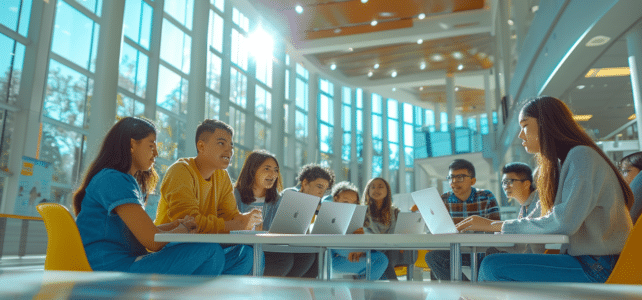
In the digital age, mastering digital tools has become a fundamental skill for students. Educational institutions, aware of this necessity, are deploying online portals that provide access to a multitude of services: course registration, grade consultation, administrative management, educational resources, and exchange forums. These centralized platforms are designed to enrich the educational experience and prepare young people for the realities of an increasingly dematerialized professional world. Adapting to these interfaces can be a challenge, especially for those who are not digital natives.
Institution Portals: Digital Tools at the Service of Students
Institution portals are at the forefront of students’ quest for autonomy in the digital world. These online platforms, such as the CNAM student portal, embody the pivot of interaction between young scholars and educational institutions. They not only offer essential academic resources but also vital services, such as the online kiosk, enabling smooth and personalized management of the student curriculum. Institutions like the Maison France Services de la Côtière also participate in this dynamic by assisting students in the use of everyday digital and computer tools, thus ensuring a smooth transition to complete digital autonomy.
France Diplomacy, in synergy with the Ministry of Europe and Foreign Affairs, offers enriching educational resources, providing educational files, interactive maps, and thematic bibliographies. The student portal, described as the entry page for academics, echoes this educational offering by centralizing access to these resources, such as the Images database, which complements the documentary arsenal available to curious and knowledge-hungry students.
In the same spirit, Onisep is making significant efforts to inform and guide students on future training and careers. Its onisep services portal serves as a compass in the ocean of training and career project choices, guiding young people and their families with precision and relevance. The convergence of these digital initiatives within student portals equips future graduates with an essential compass to navigate confidently in the vast world of education and beyond, into their future careers.
Mastering Portal Features to Optimize the University Journey
Mastering the features of institution portals is crucial for students eager to optimize their university journey. These interfaces, designed to facilitate access to educational resources, require familiarity with their multiple services. The Association of Language Industry Professionals (APIL) brings together and represents the industries of automatic language processing, offering educational tools such as DemoTal, a platform rich in case studies and supported by the General Directorate of the French Language and Languages of France (DGLFLF). DemoTal, as an innovative educational tool, illustrates the ability of portals to adapt to the constant evolution of teaching and research in innovation.
Beyond linguistics, cybersecurity emerges as an essential field of competence in the digital age. The Mallette Cyber, an educational resource freely accessible as open source, includes a teaching booklet designed to educate students on the challenges of cybersecurity. This initiative is part of a broader perspective of educational guidance and adaptation to labor market needs, where the DGESIP (General Directorate of Higher Education and Professional Insertion) actively contributes to the implementation of high school reform and the establishment of 54 hours dedicated to guidance.
Artificial intelligence, a hot topic of the moment, is also integrated into university programs and educational resources available through institution portals. The Montreal Pole for Higher Education in Artificial Intelligence (PIA/PIM) mobilizes a network of researchers and educators to develop a teaching kit on the ethics of artificial intelligence, echoing the Montreal Declaration. This underscores the importance of an ethical approach in learning about artificial intelligence and the necessity for students to embrace these educational tools to navigate wisely in their future profession.